
At the border the same consignment is read twice, by people who never speak to each other.
A commercial invoice and a packing list describe the same shipment for different readers. The invoice carries value, currency and terms of sale, and it is read by the officer assessing customs value and, where payment runs through a bank, by the checker settling the credit. The packing list carries packages, weights, measurements and marks, and it is read by the officer examining the cargo, the warehouse and the forwarder.
What follows is the comparison itself: who reads which, what they do with it, and what has to hold between the pair. Drafting either document is answered elsewhere — how to write a commercial invoice goes field by field, and how to write a packing list covers the four values it has to reconcile to the invoice.
What is the difference between a commercial invoice and a packing list?
A commercial invoice is the seller's demand for payment: who is selling to whom, what the goods are, how many, at what price, in what currency and on what terms of sale. A packing list is the seller's statement of how that same shipment is physically packed: how many packages, what is in each, what they weigh net and gross, what they measure, and what marks are stencilled on them.
The difference that matters in practice is not the fields but what happens next: the invoice goes to people deciding an amount of money, and the packing list to people handling freight.
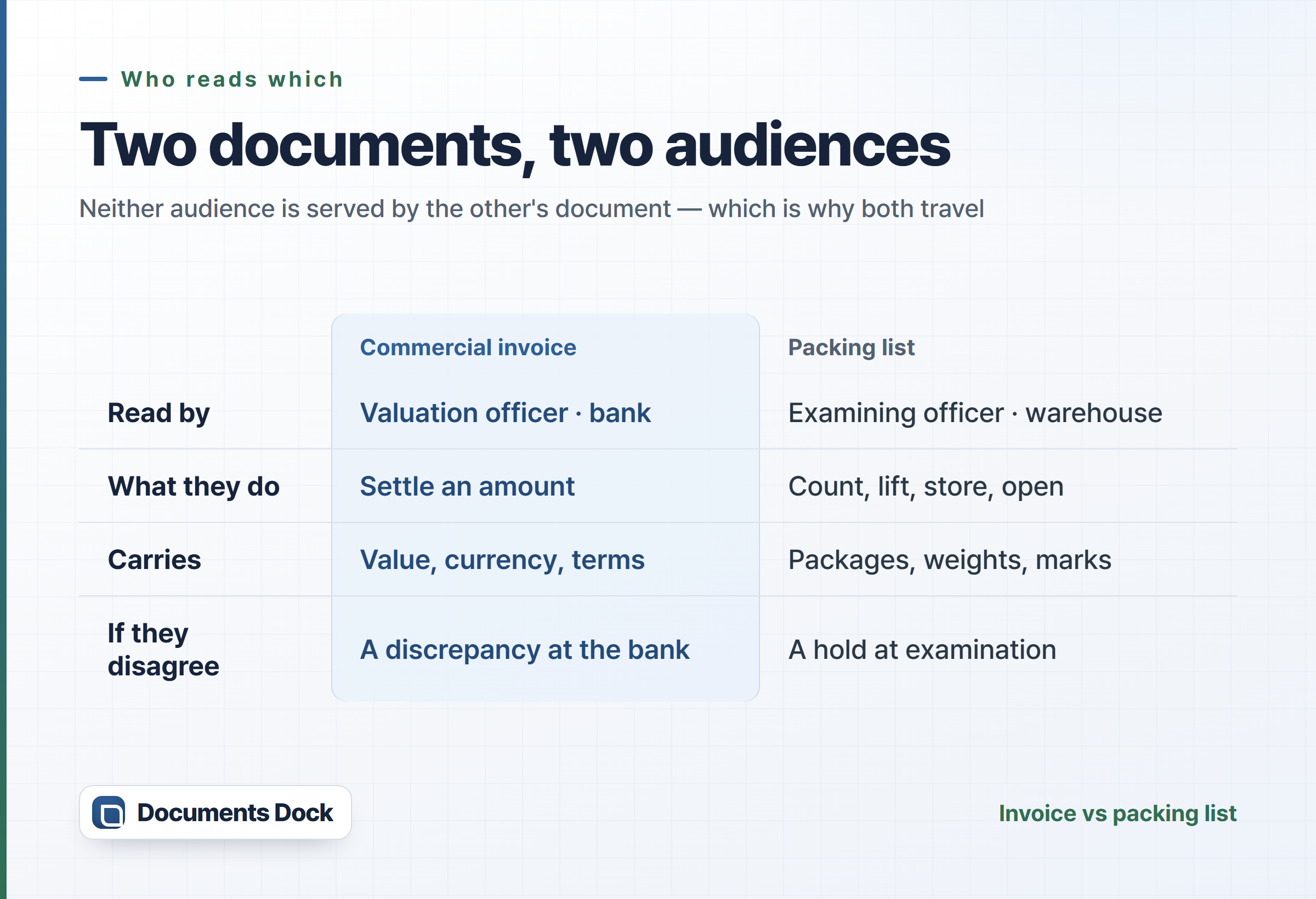
Who reads the commercial invoice, and what do they do with it?
Two readers work from the commercial invoice: the officer assessing the customs value and, where payment runs through a bank rather than on open account, the checker settling a documentary credit or collection. Both are settling an amount, and both start from the invoice. Neither is bound by it — customs may question a declared transaction value, and a bank may refuse a presentation — but it is the document each of them opens first.
What the officer tests is whether the invoice figure is the price actually paid or payable, and what the WTO valuation agreement requires to be added to it — with certain post-importation costs left out where the invoice identifies them separately. So the terms-of-sale line is read as closely as the total: quoted on a rule that carries freight to destination, the figure already contains part of the journey; quoted at the factory gate, it does not (who pays for shipping, insurance and customs).
The bank applies a different test to the pair than customs does — one run entirely on the face of the papers. Under a documentary credit governed by UCP 600, data in one stipulated document must not conflict with data in any other stipulated one (article 14(d)) — the standard is 'must not conflict', not 'must be identical'. Where the credit calls for a packing list, one that contradicts the invoice can become a discrepancy at the bank counter on a shipment customs never queried; where it does not, the bank disregards the document (article 14(g)).
Who reads the packing list, and what do they do with it?
Three readers work from the packing list: the officer examining the cargo, the warehouse or terminal handling it, and the forwarder or carrier planning and rating the load. None of them is deciding the value of the goods; all of them are acting on the consignment physically in front of them — the forwarder prices the carriage from its weight and cube, not from what is inside it.
The packing list is what makes a partial examination possible. An officer verifying one line does not unpack a container — they work out which cartons hold that line and open those, which works only if the breakdown and marks match what is stencilled on the boxes. The figures that appear here and nowhere else — dimensions, the cubic total, per-package weights — are what the carrier planned and rated the load on at booking, and what the packing list has to confirm.
It is also why prices do not belong on this document. A packing list is routinely handed to parties with no business seeing your margins: the warehouse staging the cargo, the haulier collecting it. Copying invoice values onto it adds no rigour — it puts your prices on the paper that travels with the freight.

A third weight that is not a mismatch
For containerised sea freight, the SOLAS container weight requirements in force since 1 July 2016 oblige the shipper — the party named as shipper on the bill of lading, which is not always the seller who wrote the packing list — to give the carrier and terminal a verified gross mass for each packed container before loading. That figure includes the container's own tare weight, so it will not equal the gross weight on your packing list — and the difference is not a discrepancy.
Which fields must agree, and how do you test it?
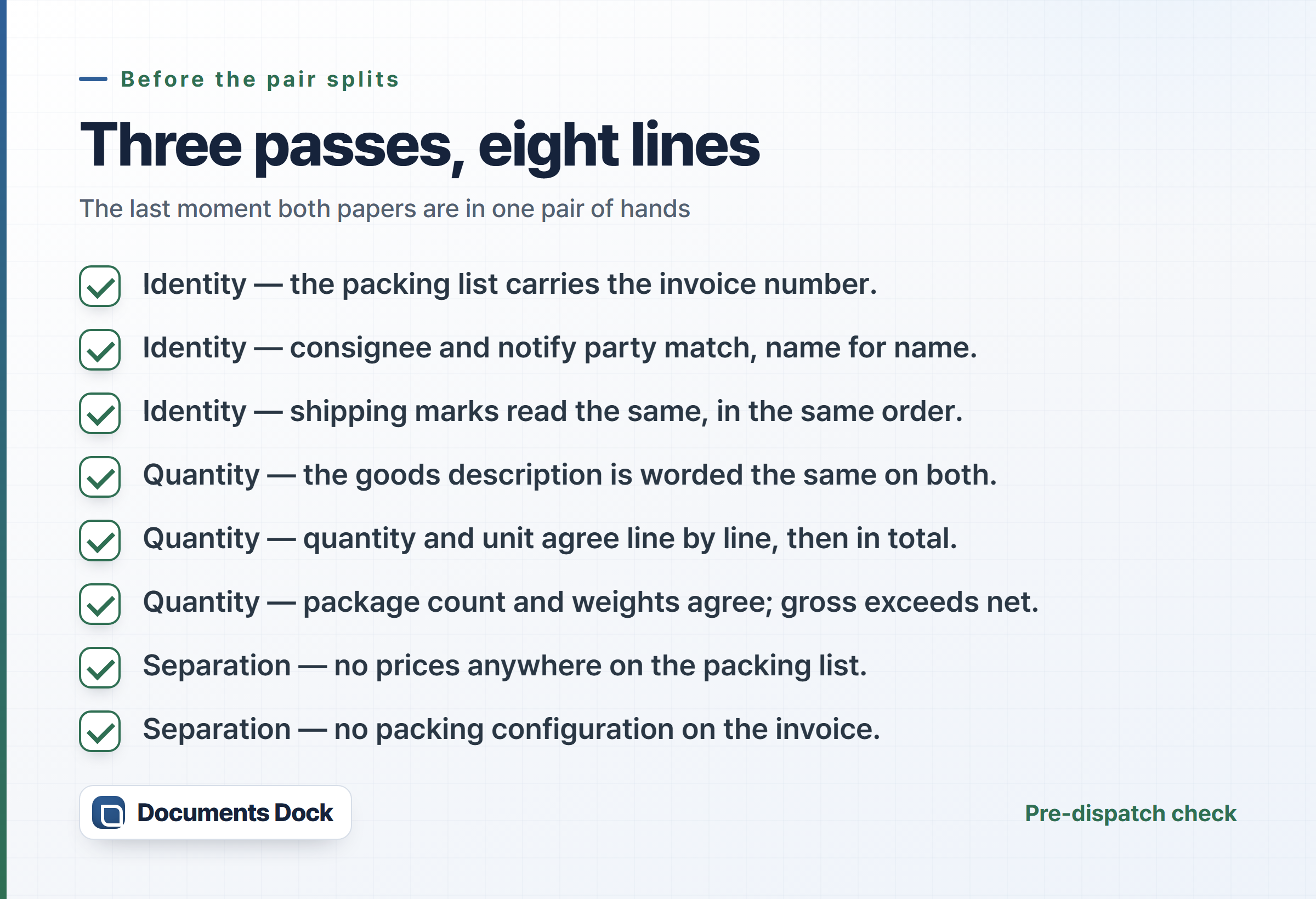
The fields that have to agree are the ones two different readers act on from two different papers: the goods description, the quantity and its unit, the package count and the weights, plus the invoice number, the consignee and the shipping marks. The first four are worked through in the packing list guide; what it leaves open is the test — how you compare the pair, and which document you believe when they differ.
Compare lines before totals. Both papers can show 600 units. Put 300 and 300 across the two products on the invoice, and 400 and 200 on the packing list, and the totals still agree — while the two documents describe different shipments. A check that stops at the grand total passes a pair that an examining officer fails at the second carton.
Then decide, field by field, which document is the source. No rule ranks these papers — a bank requires only that they not conflict — so what follows is the working convention document checkers use. The invoice is the source for value, currency and terms of sale; the packing list for packages, weights, measurements and marks. The transport document is a third place the same weight and package count appear, not an independent measurement: carriers normally reserve the particulars you supply — said to contain, shipper's load and count — so the bill of lading repeats your figures rather than verifying them.
Three fields carry that test and belong to neither reader alone:
- **The invoice number on the packing list** — the thread every later document follows back to one sale. A packing list carrying no invoice reference has to be matched by hand at every desk it reaches; it is the cheapest field to add.
- **The consignee, and the notify party where the packing list carries one** — the same legal name, spelled the same way on both papers; a trading name on one and a registered entity on the other reads as two parties at a bank counter. A notify party has to match the transport document, and it is the field most likely to survive a copy-paste from the last shipment.
- **Shipping marks and package numbers** — the only fields that connect a line on paper to a carton on a warehouse floor. Where the invoice carries marks too, they must be the same marks in the same order.
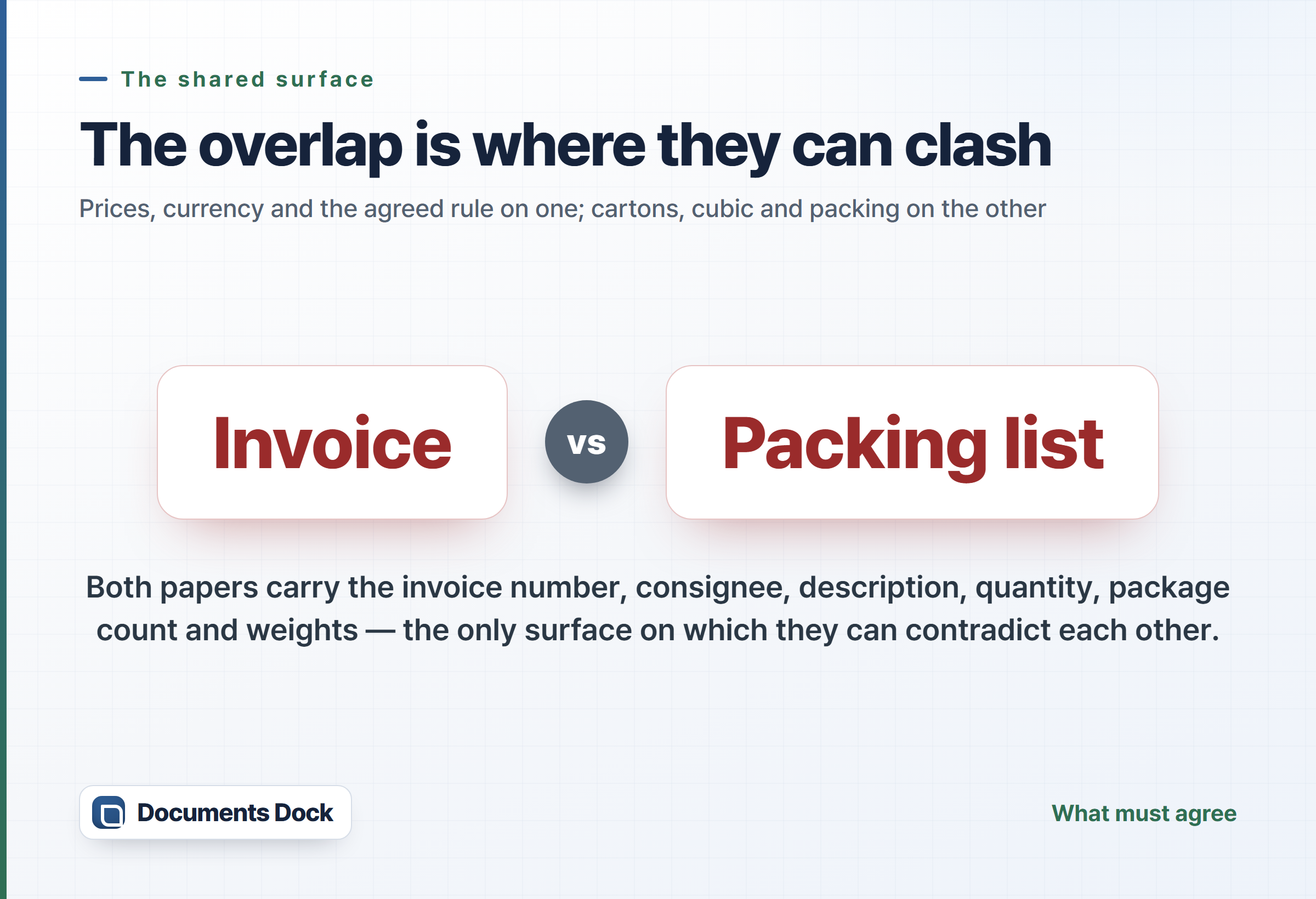
Lines first, then totals
A pair that agrees on the grand total and disagrees line by line is harder to see and just as likely to stop a shipment. Read the two documents down their line items together, and only then check that the totals still land.
Do you need both, or can one combined document do the job?
You normally need both. Some lanes and some buyers accept a combined 'invoice cum packing list' carrying both data sets on one form. Whether it is accepted is decided by the destination's requirements and, where payment runs on a credit, by the credit's wording — confirm it with a licensed customs broker and your bank. Under a credit it also has to be presented in the number of originals the credit asks for across both documents: one original will not answer a call for an original invoice and an original packing list.
The trade-off is a readers' one. One form removes the transcription gap behind most mismatches, because there is only one place to write the quantity. It also removes the separation: you can no longer give the warehouse what it needs without giving it your prices.
When the two disagree, which one is right?
Neither, automatically. Settle it from the sales contract and the loading record — what was agreed, and what actually shipped — then correct the wrong document at the party that issued it and retire the superseded copies. The disagreements that recur are worked through field by field in the commercial invoice mistakes that get shipments held.
Check the pair before it splits
The last moment the two papers are in one pair of hands is the moment before they go to different recipients. Use it for three passes — identity, then quantity line by line before totals, then separation — set out in the card below. For where the pair sits in the sequence, see the full export document set, in order. If a submission has already come back, start at why customs rejects your documents.
The invoice and the packing list go to different desks, and each desk should get only what it is meant to see. Documents Dock assembles the set each recipient receives — broker, bank, forwarder — from a single shipment record, so the split is decided once instead of improvised at the point of sending. See it at documentsdock.com.
Sources and scope
This is general information, not customs, banking or compliance advice. Which fields your documents must carry, whether a combined invoice and packing list is accepted, and what an authority or bank treats as a defect depend on your goods, countries and terms of sale — confirm the requirements for your lane with a licensed customs broker, your bank, or the relevant customs authority.
- International Chamber of Commerce (ICC) — Incoterms 2020 rules — iccwbo.org/business-solutions/incoterms-rules/incoterms-2020
- International Chamber of Commerce (ICC) — Uniform Customs and Practice for Documentary Credits (UCP 600), articles 14(d) and 14(g) — iccwbo.org
- International Chamber of Commerce (ICC) — International Standard Banking Practice (ISBP 745), documents covering more than one function — iccwbo.org
- World Trade Organization — Agreement on Implementation of Article VII of GATT 1994 (customs valuation), article 8 and the Interpretative Note to article 1 — wto.org/english/tratop_e/cusval_e/cusval_e.htm
- UN/CEFACT — United Nations Layout Key for Trade Documents, Recommendation No. 1 — unece.org/trade/uncefact
- U.S. International Trade Administration — Common Export Documents (commercial invoice, packing list) — trade.gov/common-export-documents
- International Maritime Organization — SOLAS chapter VI, regulation 2: verified gross mass of packed containers, in force 1 July 2016 — imo.org