
When a shipment is held for a “commercial invoice error”, the invoice is seldom wrong on its own. Its figures have simply stopped agreeing with the papers beside it — the packing list, the bill of lading — and customs reads them together.
A commercial invoice holds a shipment when its details contradict the rest of the document set: a declared value, quantity, goods description, Incoterms rule, or consignee that disagrees with the packing list or bill of lading. Customs cross-reads the papers, so the remedy is reconciling them, not correcting a single line.
This guide walks the mistakes that recur, and why each is better read as a disagreement between documents than as a typo on one. It covers document-side holds; a physical examination or a licensing question runs on a different track. Where a mistake feeds a wider hold, see shipment held at customs; where it is a matter of writing the invoice correctly in the first place, see how to write a commercial invoice.
Why do commercial invoice errors hold a shipment at customs?
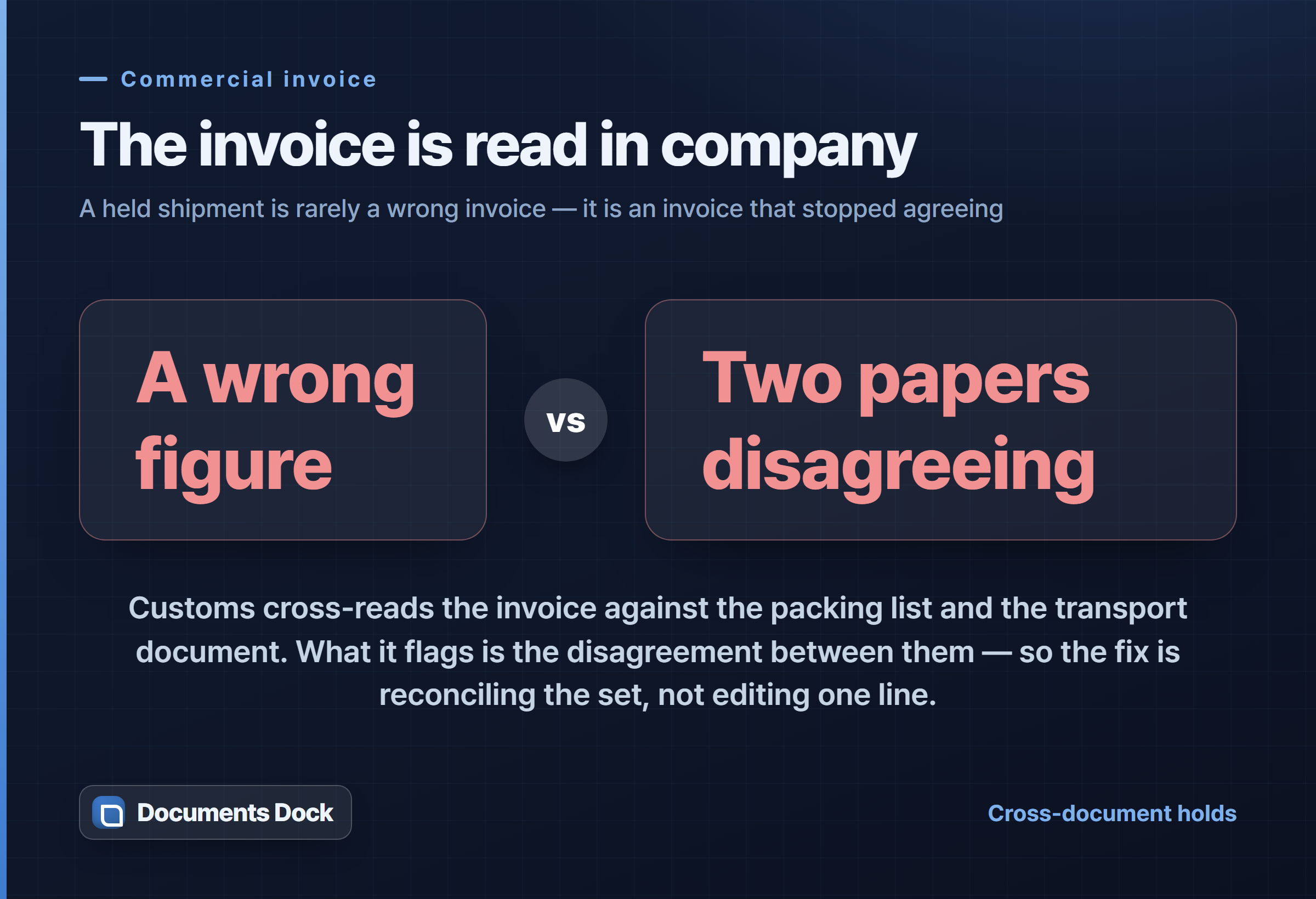
Customs assesses duty and verifies a consignment from the declaration, and the declaration is built from your documents. When the commercial invoice states one thing and the packing list or bill of lading states another, the officer cannot tell which is true — so clearance pauses until the set agrees. The hold is a question about consistency, not a penalty for a wrong figure.
A commercial invoice is the seller’s record of the transaction — the parties, the goods, the price, and the terms of sale. Customs uses it to establish the transaction value, which is normally the starting point for assessing duty, though the authority may look further where the papers disagree or the parties are related. The bank reads the same invoice in a documentary credit. Both read it against the other papers.
That is why a value which is internally fine — the maths adds up — can still stop a shipment if it does not match the version the declaration was filed from.
The invoice is read in company
A figure that is correct on the invoice but absent, rounded, or restated on the packing list or transport document is still a discrepancy in the officer’s eyes.
What are the most common commercial invoice mistakes?
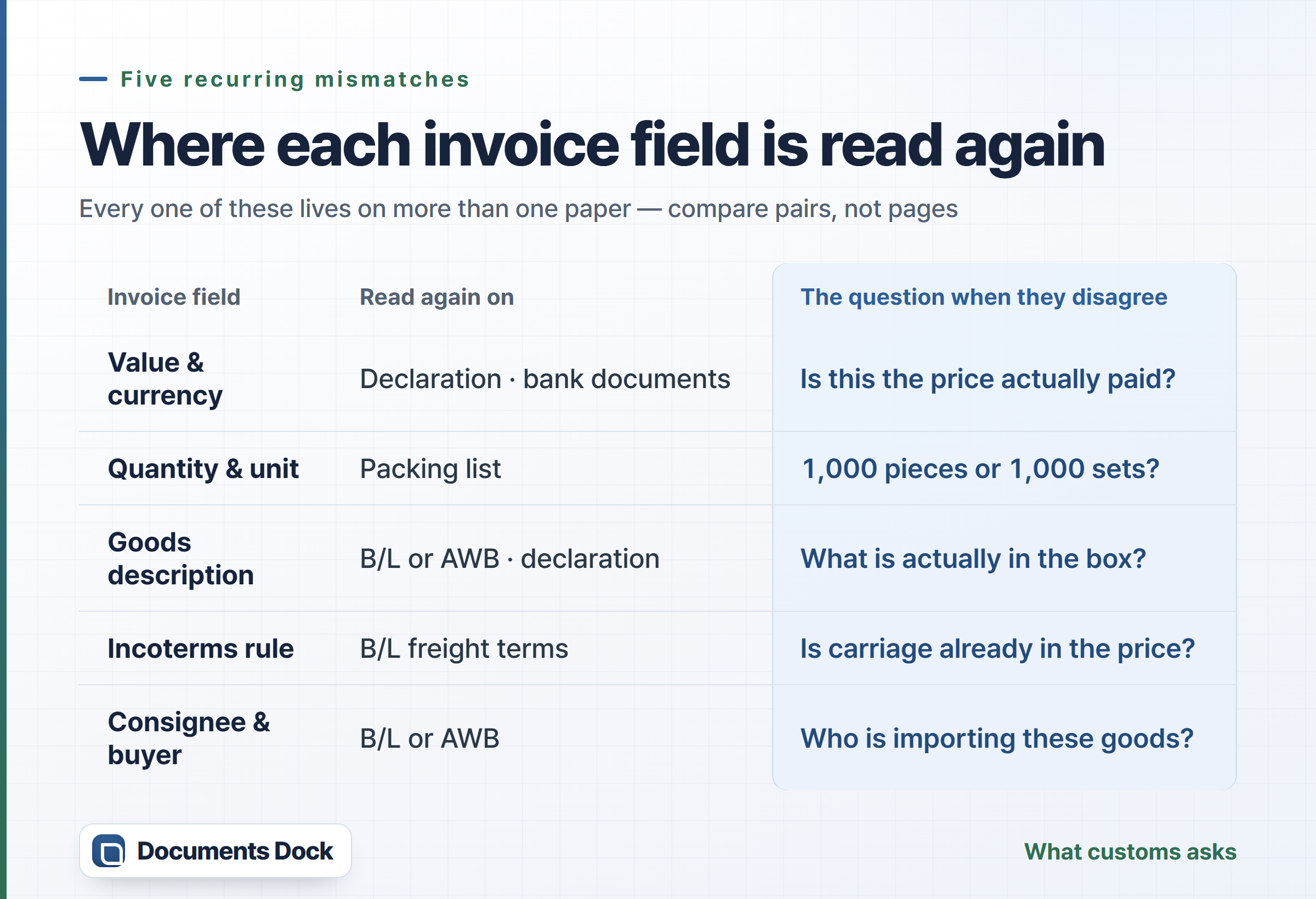
The commercial invoice mistakes that most often hold a shipment are: a declared value or currency that does not reconcile; a quantity or unit that disagrees with the packing list; a goods description too vague to classify or inconsistent across papers; an Incoterms rule that contradicts the freight terms; and a consignee or buyer that does not match the transport document. Each is a mismatch, not a lone typo.
- **Value and currency** — the invoice total, the currency, or the version filed. A declaration filed from a draft invoice at USD 21,300 when the final reads USD 23,100 looks like undervaluation and is really a stale file. State the currency; make the line items sum to the total.
- **Quantity and unit** — 1,000 pieces on the invoice against 1,000 sets on the packing list is a tenfold difference in someone’s reading. Keep the unit identical across the invoice and packing list (PCS, SET, CTN), and let the totals reconcile.
- **Goods description** — “parts” or “samples” is too thin for the officer to classify, and a description that reads one way on the invoice and another on the bill of lading invites a query. Describe what customs classifies on, and keep the wording the same across the set.
- **Incoterms rule** — an invoice marked FOB beside a bill of lading stamped “freight prepaid” contradicts who bears the freight, leaving the transaction value unclear: is carriage inside the price or not? State the Incoterms 2020 rule with its named place (“FOB Port of Singapore”), and make it agree with who actually paid.
- **Consignee and buyer** — an invoice billed to one entity while the bill of lading names a sister company can be legitimate, but the declaration must name the right importer of record and the papers must support it. A mismatch here draws the “who is importing these goods?” question.
How do you fix a commercial invoice that customs has flagged?
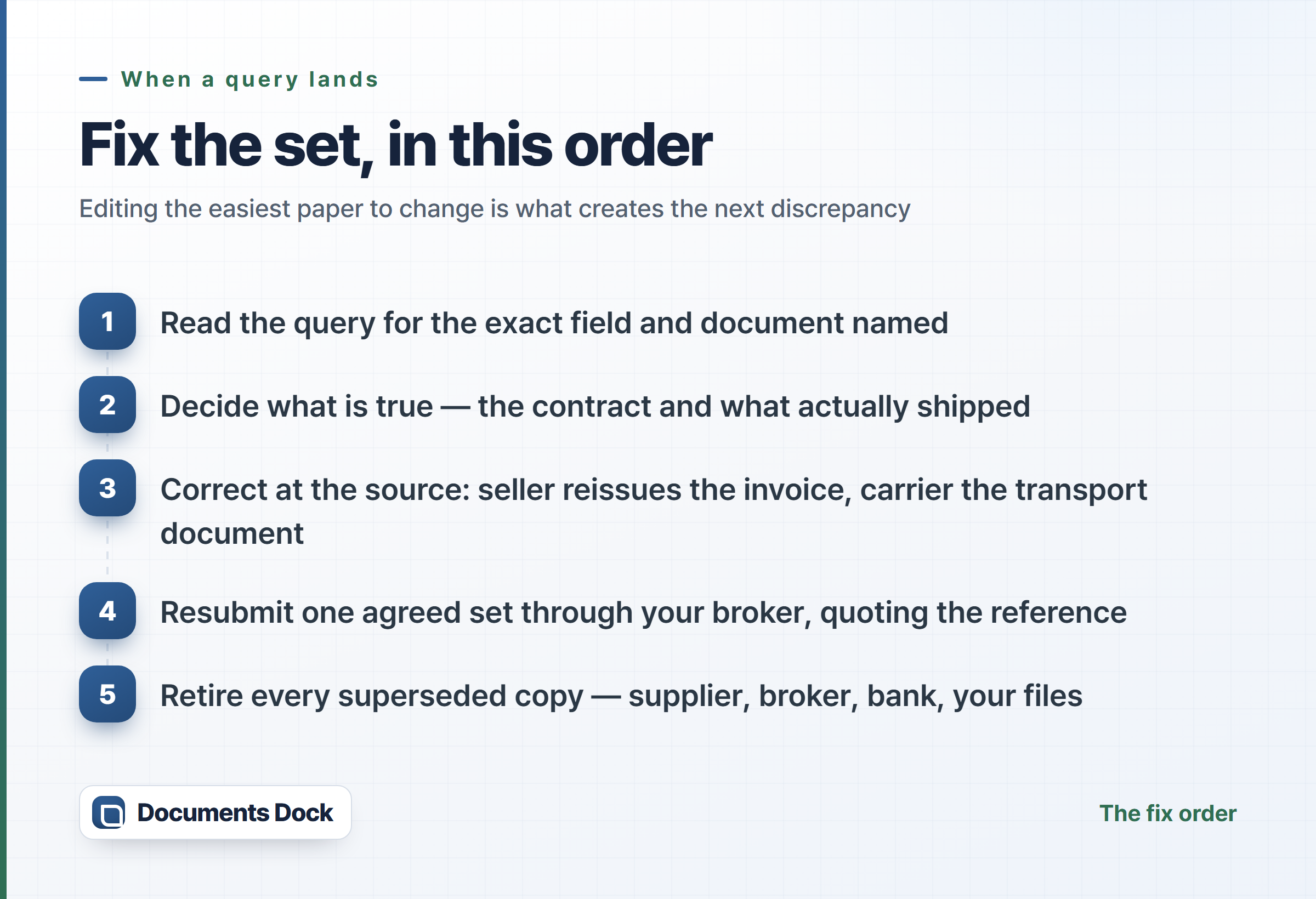
You fix a flagged commercial invoice by reconciling it with the rest of the set, not by editing the invoice in isolation: identify which field the query names, decide which document holds the true value, correct that document at its source and reissue it, then resubmit one agreed set and retire every older copy. Editing the easiest paper to change is what creates the next discrepancy.
- Read the query for the exact field and document named — value, description, consignee.
- Decide what is true from the contract and what actually shipped, not from whichever paper is quickest to amend.
- Correct at the source: the seller reissues the invoice, the carrier the transport document. A number changed only on the copy in front of you will disagree with the original later.
- Resubmit a single consistent set through your customs broker, quoting the entry or query reference.
- Retire the superseded versions with everyone who holds one — supplier, broker, bank, your own files — so a later check finds one story.
Fix the document that is actually wrong
Amending the invoice to match a wrong packing list, or the reverse, clears today’s query and seeds tomorrow’s.
Reconcile before the set reaches your broker
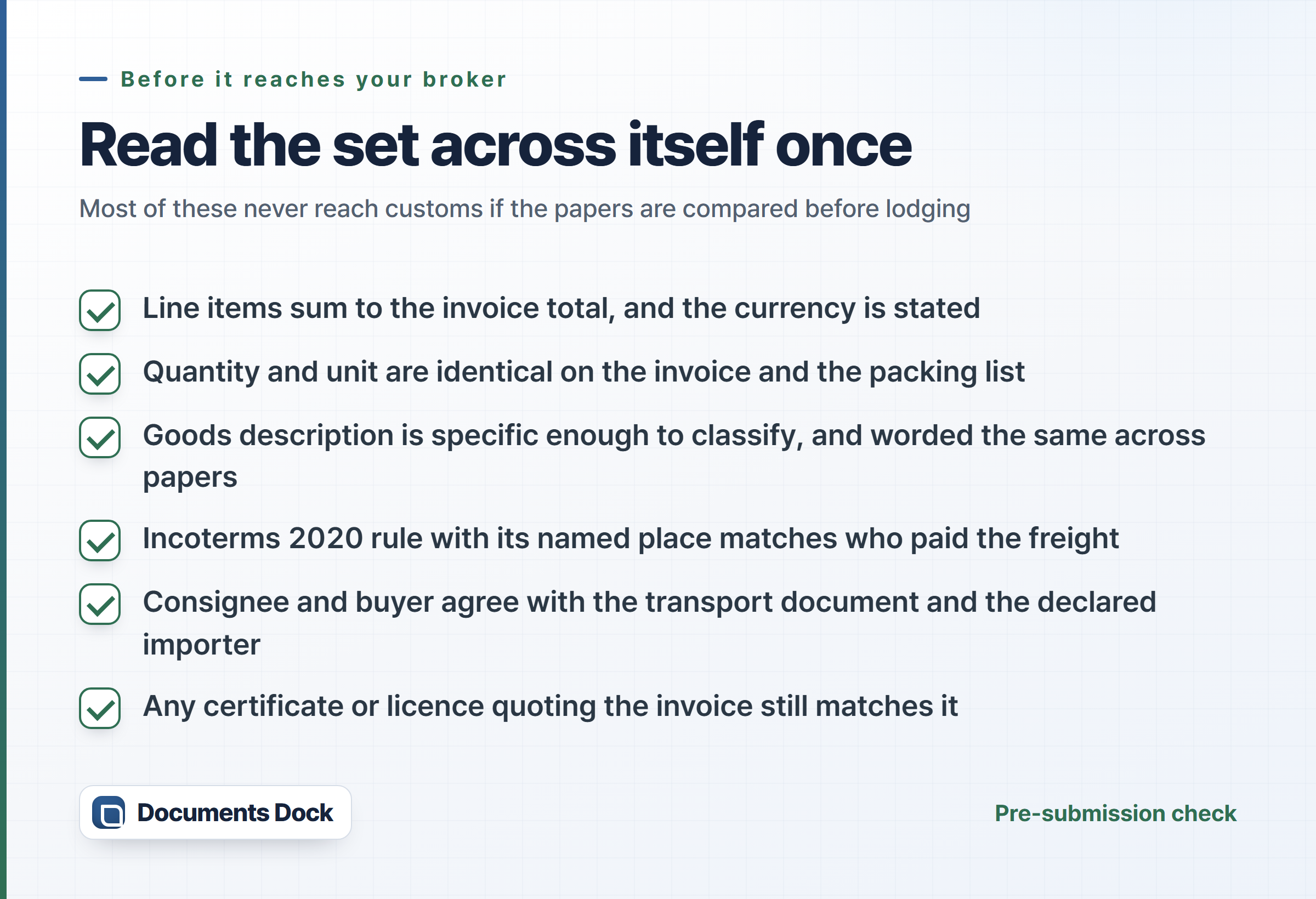
Most of these never reach customs if the set is read across itself once, before it is lodged. The invoice, the packing list, and the transport document should agree on value, quantity, description, terms, and parties; where a certificate or licence quotes the invoice, it has to match too. The discipline is the same one behind the full export document set, in order — build the set to agree, rather than assembling it and hoping.
Documents Dock flags where quantities, amounts, and parties disagree across your commercial invoice, packing list, and transport documents — per shipment, in one place, before you submit.
Sources and scope
This is general information, not customs or compliance advice. Whether a specific figure, description, or filing is treated as a discrepancy depends on your goods, countries, terms, and the authority involved — confirm with a licensed customs broker or the relevant customs authority.
- World Customs Organization (WCO) — Customs Valuation (wcoomd.org)
- International Trade Administration, trade.gov — Commercial Invoice guidance (trade.gov)
- International Chamber of Commerce (ICC) — Incoterms® 2020 (iccwbo.org)