
The first deadline on a U.S. import falls before the ship leaves the foreign port. Twenty-four hours before your cargo is laden, a filing has to be with U.S. Customs and Border Protection — long before the goods are anywhere near the United States.
A U.S. import requires an entry filed with CBP by the importer of record, or by a licensed customs broker acting for them, supported by a commercial invoice, evidence of the right to make entry, a customs bond, and any agency certificates or preference claims the goods attract.
Almost none of it is handed across a counter. CBP takes data, filed electronically, and the documents stay with you — produced when asked, sometimes years after the goods were sold on, and returned through ACE's document imaging rather than by post. This is the destination-side checklist for the United States; for the export side of the same shipment, read the full export document set, in order.
When is each U.S. import filing due?
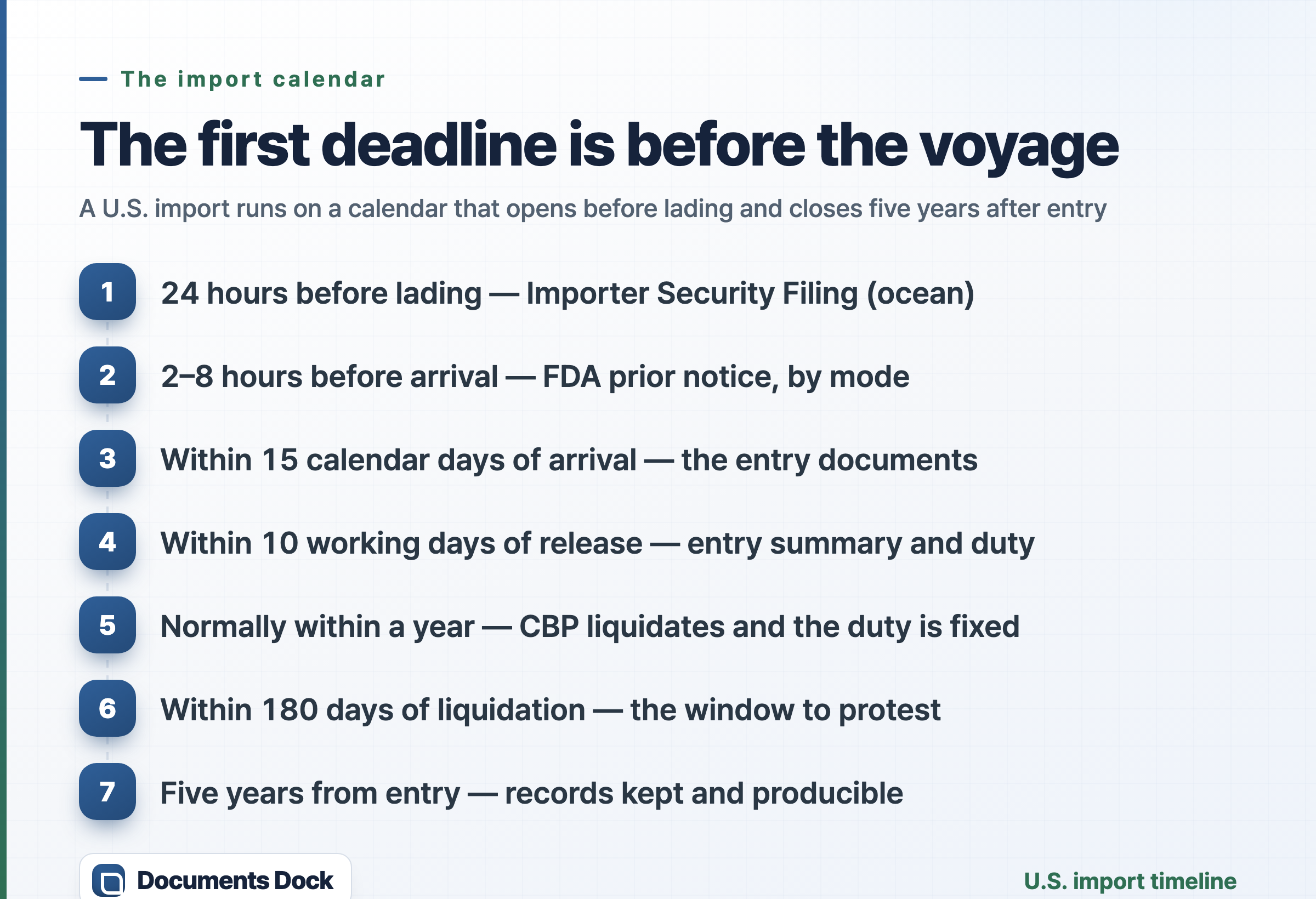
A U.S. import runs on a calendar that opens before the voyage and closes five years after the entry. These are the fixed points; everything else is held rather than lodged.
- **24 hours before lading** — the Importer Security Filing, for ocean cargo. Eight of the ten importer elements are due then; the stuffing location and the consolidator can follow, no later than 24 hours before arrival. Bulk cargo, and break bulk exempted from the 24-hour manifest rule, file 24 hours before arrival instead. Air cargo has no mandatory importer-side filing: advance security data goes under ACAS from the carrier or another eligible filer.
- **Two to eight hours before arrival, by mode** — FDA prior notice for food: two hours by land, four by air or rail, eight by water. It can travel via ABI with the entry, or separately through FDA's own system.
- **Within 15 calendar days of arrival** — the entry documents.
- **Within 10 working days of release** — the entry summary, with the duty deposit. On a periodic monthly statement, payment moves to a set day the following month.
- **Normally within a year of entry** — CBP liquidates: the entry is finalised and the duty fixed. The period can be extended, to a maximum of four years from entry.
- **Within 180 days of liquidation** — the window to protest. A post-importation preference claim runs on its own clock: one year from importation.
- **Five years from the date of entry** — how long the records behind the entry must be kept and producible.
The five parties on one U.S. entry
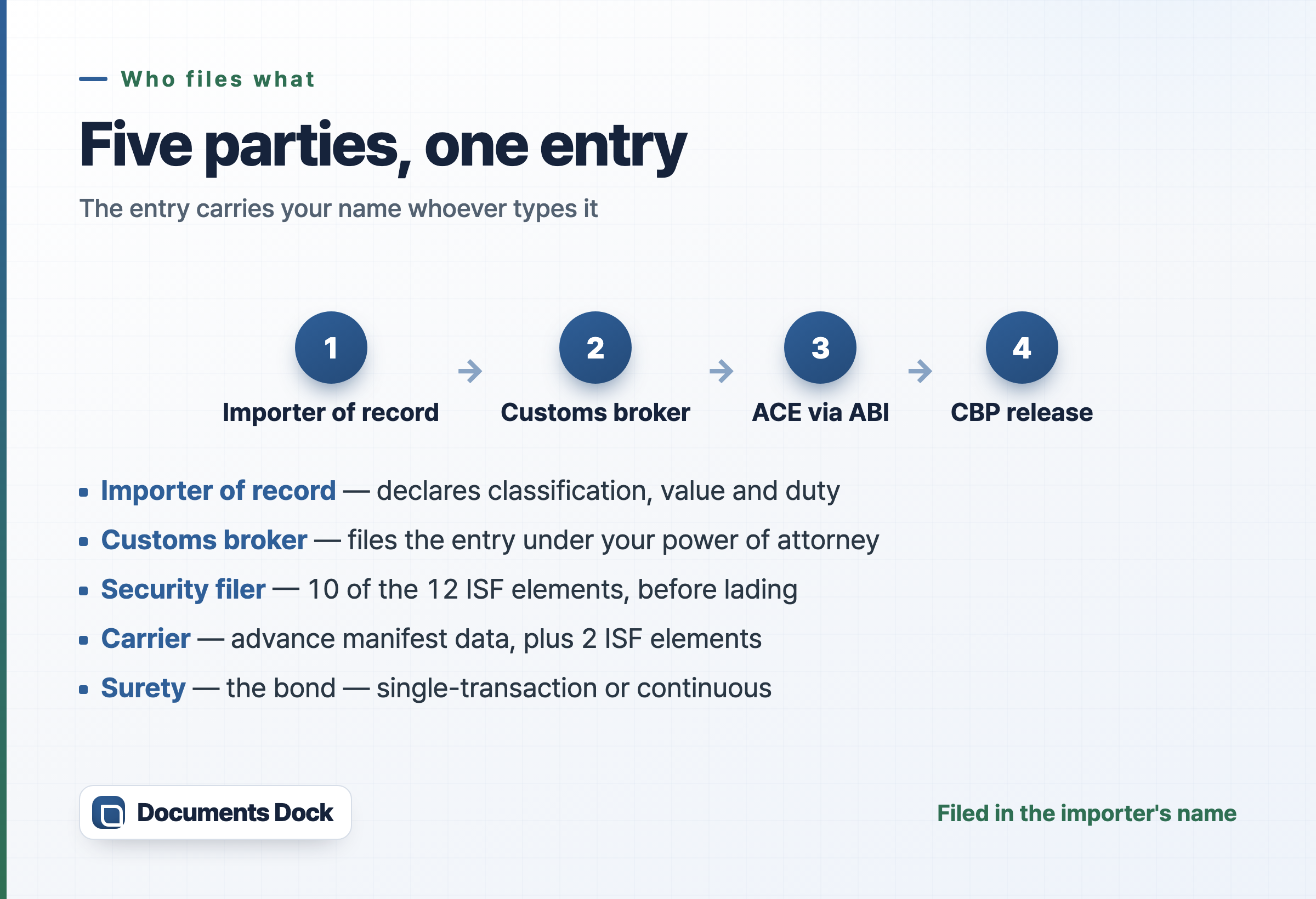
The importer of record files — in practice through a licensed customs broker acting under a power of attorney. The importer of record is the party answerable to CBP for an entry: the owner or purchaser of the goods, or a licensed broker appointed by the owner, purchaser or consignee. That party declares the classification and the value, pays the duty, and owes CBP reasonable care in doing it.
Four other parties touch the same shipment, and each files something different.
- **Importer of record** — needs an identification number and a customs bond in place before an entry can be filed. A foreign company can be the importer of record, but has to designate a U.S.-based agent for service of process.
- **Licensed customs broker** — files the entry and the entry summary under your power of attorney. The licence lets them transmit the entry; it does not make them the declarant. Unless separately appointed as importer of record, the entry is filed in your name.
- **The security-filing party** — for ocean cargo, the party causing the goods to arrive, or its agent. Ten of the twelve data elements come from there.
- **The carrier** — transmits the advance cargo data for the manifest, plus the vessel stow plan and container status messages.
- **The surety** — issues the bond. A single transaction bond covers one entry; a continuous bond covers a year of entries at every port.
The broker files it; you answer for it
Appointing a broker moves the typing, not the liability. Classification, valuation and origin are declared under the importer of record's reasonable-care obligation — which is why a code or a value you passed along unchecked is still yours at a post-entry review. The broker carries its own licence obligations and can be penalised for its own failures; that is a separate liability, not a transfer of yours.
What CBP expects with every entry
Four items carry a standard commercial entry: the entry filing, evidence of the right to make entry, a commercial invoice, and a customs bond. Everything beyond those is conditional on what the goods are and what is claimed for them.
Entry type follows value — except that quota-class and certain restricted goods require a formal entry whatever they are worth. Above the formal-entry threshold, generally $2,500, a formal entry is required; below it, an informal entry may be available. Duty-free treatment under the $800 administrative exemption was suspended for all countries by executive order effective 29 August 2025, and commercial de minimis is repealed by statute from 1 July 2027 — check the current rule with CBP or your broker before you rely on it.
- **Entry / immediate delivery filing** (CBP Form 3461, in practice its electronic equivalent) — the request to release the cargo.
- **Entry summary** (CBP Form 7501) — classification, value, duty and the arithmetic that produced them, filed after release for most entries. Quota-class and AD/CVD merchandise require live entry, with the summary and the duty deposit lodged before release.
- **Evidence of the right to make entry** — a carrier's certificate or release order naming the party entering the goods, the normal route for air and express-released ocean cargo, or an original bill of lading where one was issued.
- **Commercial invoice** — the one document whose required contents U.S. regulation writes out itself (how to write a commercial invoice). A pro forma invoice can stand in where it cannot be produced at entry, with the real one following, normally within 120 days.
- **Customs bond** — continuous or single-transaction, in place before filing.
- **Packing list**, where the goods are packed in more than one package, or the invoice cannot itself detail each package's contents.
- **Preference documents** — the origin certification the relevant agreement requires, where a preference is claimed. The question is which programme's paperwork, not whether any exists.
- **Partner government agency data** — where the goods are regulated: advance notice for food, and registrations, certificates or conformity statements for other controlled categories, filed with the entry rather than alongside it.
The invoice has to be in English
An invoice in another language must be accompanied by an English translation, and it must state in adequate detail what is contained in each individual package. Both are regulation, not a preference.
Origin proof: a preference claim, or no certificate at all
The United States has no general certificate-of-origin requirement. Origin is declared on the invoice and marked on the goods; a certificate enters the picture only when a duty preference is claimed, or when a buyer or a documentary credit asks for one. Which branch you are on is settled in do you need a certificate of origin?.
**Preferential.** USMCA is the worked example here because it is the most used. A claim under KORUS, CAFTA-DR, the US–Israel FTA, the Australia, Singapore, Chile, Peru, Colombia, Panama, Morocco, Bahrain or Oman agreements, or under AGOA or CBI, carries its own certification with its own data requirements — confirm which programme covers your origin before you work from the USMCA rules.
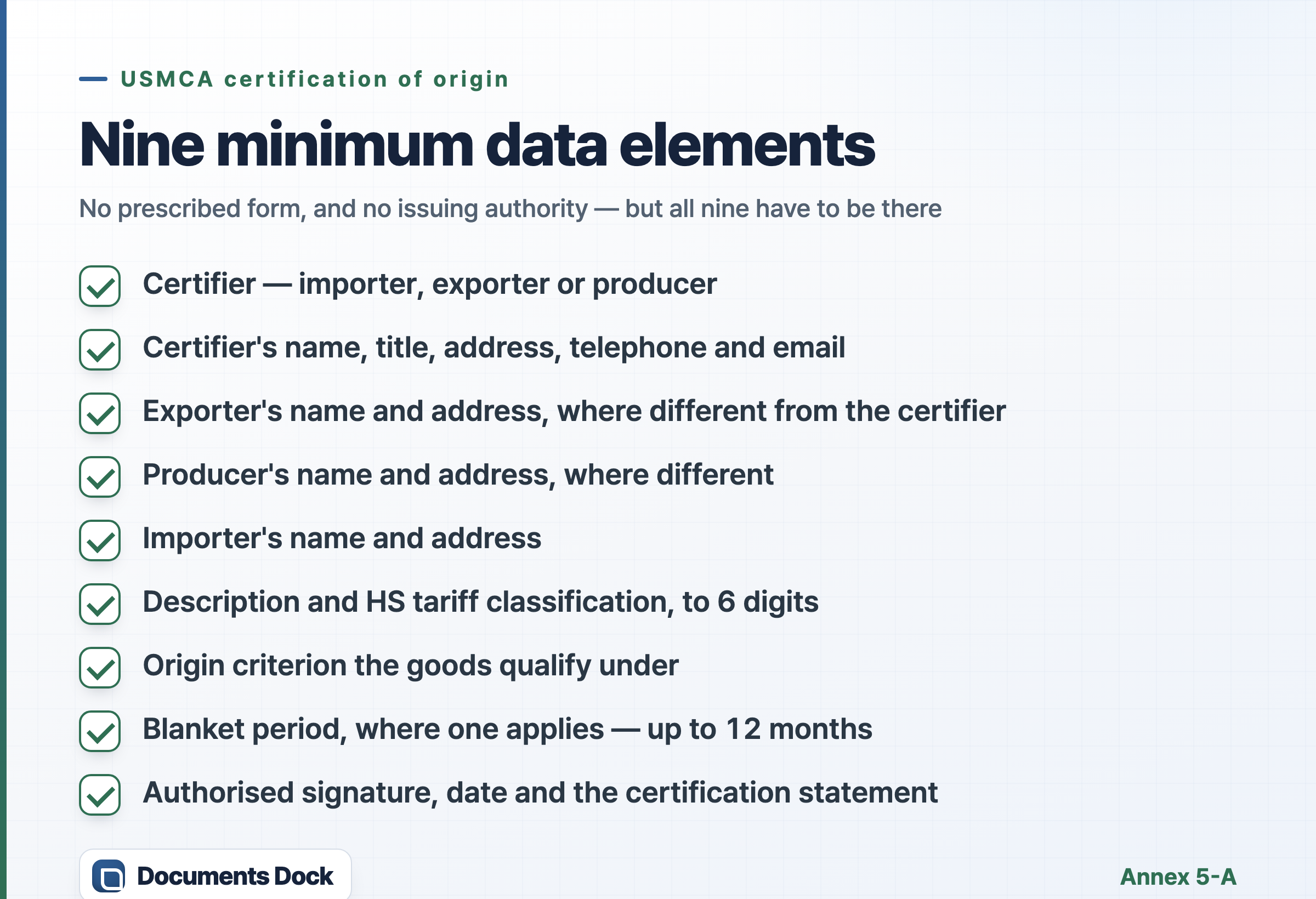
A certification of origin under the United States–Mexico–Canada Agreement has no prescribed form and is issued by no authority. It is nine minimum data elements — set out in the card below — signed and dated under the certification statement the agreement sets out, and it can sit on the commercial invoice or any other document. One certification covers a single shipment or a blanket period of up to twelve months of identical goods, and the importer must hold it when the claim is made, or claim after importation within a year for goods that qualified when they entered. It is waived at $2,500 or less (19 CFR 182.13) — the same figure as the formal-entry threshold, but a different rule — and CBP can still ask for a written statement of origin. The goods still have to qualify.
Claims fail most often on a missing element — the origin criterion, the producer's details, a signature and date — or on a blanket period that has lapsed by the entry date.
**Non-preferential.** Everything else. Where a certificate appears at all, it is because a buyer or a documentary credit asked for it — typically stamped by a chamber of commerce in the exporting country — and it buys no duty reduction.
The importer can be the certifier — and often is
Under USMCA the party claiming the preference may write and sign its own origin certification, which is unusual among preference regimes. A U.S. buyer whose supplier will not certify is therefore not blocked — but it is then the buyer's own file that has to hold the origin evidence when CBP verifies the claim.
What gets a U.S. entry queried or held?
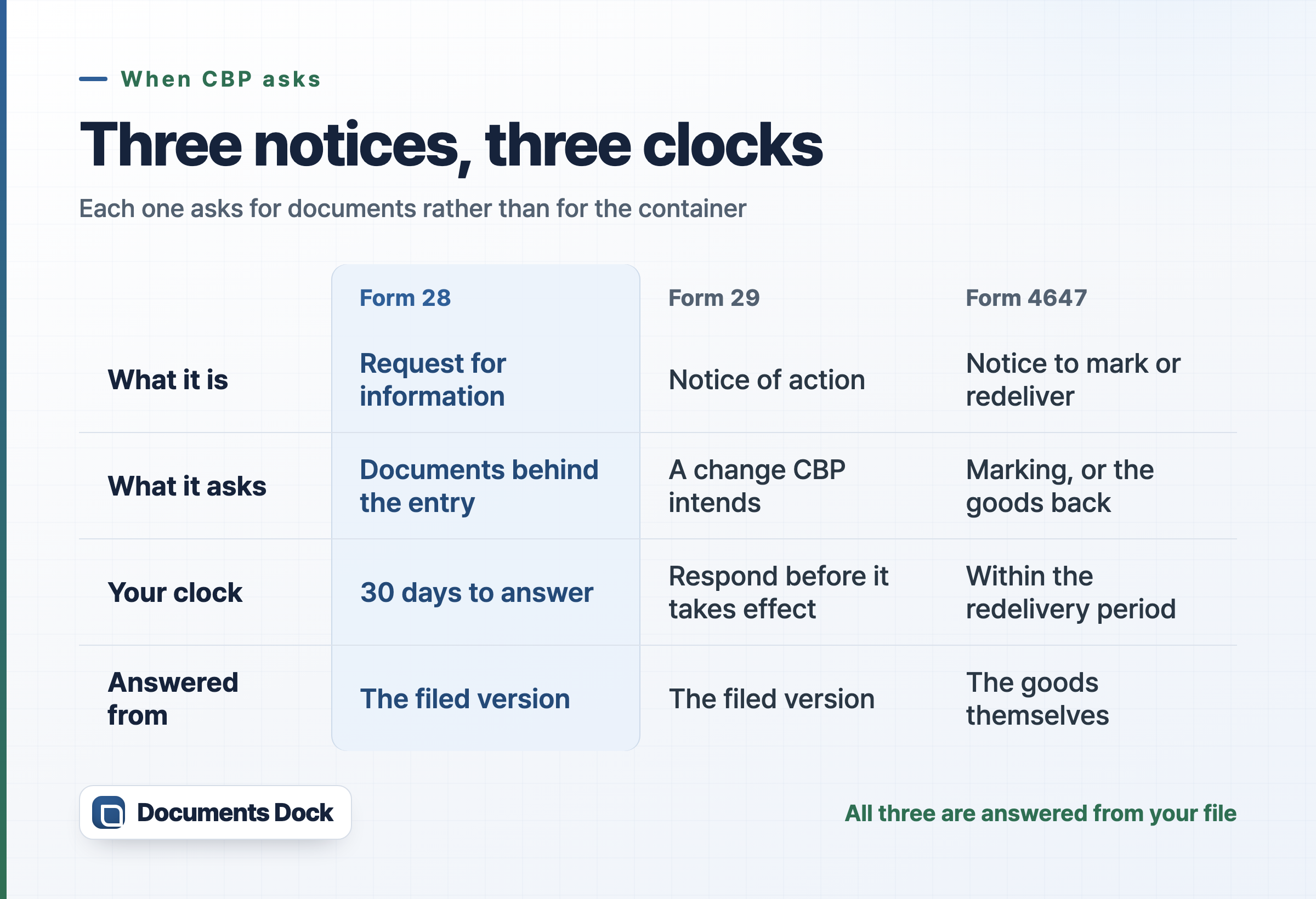
A query usually arrives as one of three CBP notices, and it asks for documents rather than for the container: a request for information (Form 28, answerable within 30 days), a notice of action (Form 29), or a notice to mark or redeliver (Form 4647, which CBP can issue only within the redelivery period that runs from release).
The cross-document failures behind most of them — an invoice short of what the regulation requires, a description too vague to carry the code (the HS code on your commercial invoice), a value that does not say whether the freight already sits inside it — are worked through field by field in why customs rejects your documents. On that last one: under transaction value, freight and insurance leave the dutiable value only where the invoice breaks them out separately, so a lump-sum CIF or DAP figure under Incoterms 2020 is dutied in full. Four failures are specific to this border.
- **A security filing that does not match the bill.** Filed late, or against a bill of lading number the carrier's data does not carry. An unmatched filing is treated as no filing, and exposes the filer to liquidated damages under the bond.
- **Goods that arrive unmarked.** Every article of foreign origin must be marked with its country of origin, legibly and as permanently as the article allows, so the ultimate purchaser can read it. Marking under supervision, redelivery, or marking duties can follow.
- **Missing agency data.** A regulated commodity entered with no advance notice, registration or certificate in the message set. The entry sits until that agency is satisfied — and CBP is often not the office that can release it.
- **A bond that will not stretch.** A continuous bond sized on last year's volumes — broadly 10% of the duties, taxes and fees paid in the previous twelve months, $50,000 minimum — runs out of capacity mid-year. CBP issues an insufficiency notice with a short window to increase it; after that, entries are rejected, though a single transaction bond can bridge individual shipments.
When CBP asks for the documents an entry was built from
The expected answer is the version the filing was made from — not a reconstruction assembled later. The request often arrives long after the goods were sold on, which is what the five-year retention period is for.
Where is a U.S. import declaration lodged?
A U.S. import declaration is lodged electronically, in the Automated Commercial Environment (ACE) — CBP's single window for trade data — transmitted through the Automated Broker Interface by a customs broker, or by a self-filing importer with the software and the account to do it. There is no counter and no paper set to hand in. Partner government agency data travels in the same message set, which is why a missing agency element stops an entry exactly as a missing customs element does. The rest of the paperwork is held rather than lodged, on the calendar at the top of this page.
The set behind the entry is the one you keep
CBP's question arrives years after the goods were sold on, and it asks for the version you filed from. Documents Dock keeps the invoice, packing list, transport document and certificates for an entry together per shipment — with the copy each filing was made from — documentsdock.com.
Sources and scope
This is general orientation, not customs or legal advice. Which documents your goods require, whether a preference is available and which agencies have an interest are set by the goods, their origin and your terms of sale, and they change without notice. Confirm the set with a licensed customs broker or with CBP before you file.
Related: Indonesia import documents and LARTAS.
- U.S. Customs and Border Protection — Importing into the United States: A Guide for Commercial Importers (cbp.gov)
- U.S. Customs and Border Protection — Importer Security Filing (10+2) (cbp.gov)
- 19 CFR 149.2 — Importer Security Filing: time of transmission (ecfr.gov)
- U.S. Customs and Border Protection — USMCA: certification of origin and the minimum data elements of Annex 5-A (cbp.gov)
- U.S. Customs and Border Protection — Automated Commercial Environment (ACE) (cbp.gov)
- 19 CFR 141.85–141.86 — Pro forma invoice; contents of invoices and general requirements (ecfr.gov)
- 19 U.S.C. 1304, 1484 and 1508 — Marking of imported articles; entry of merchandise; recordkeeping (uscode.house.gov)