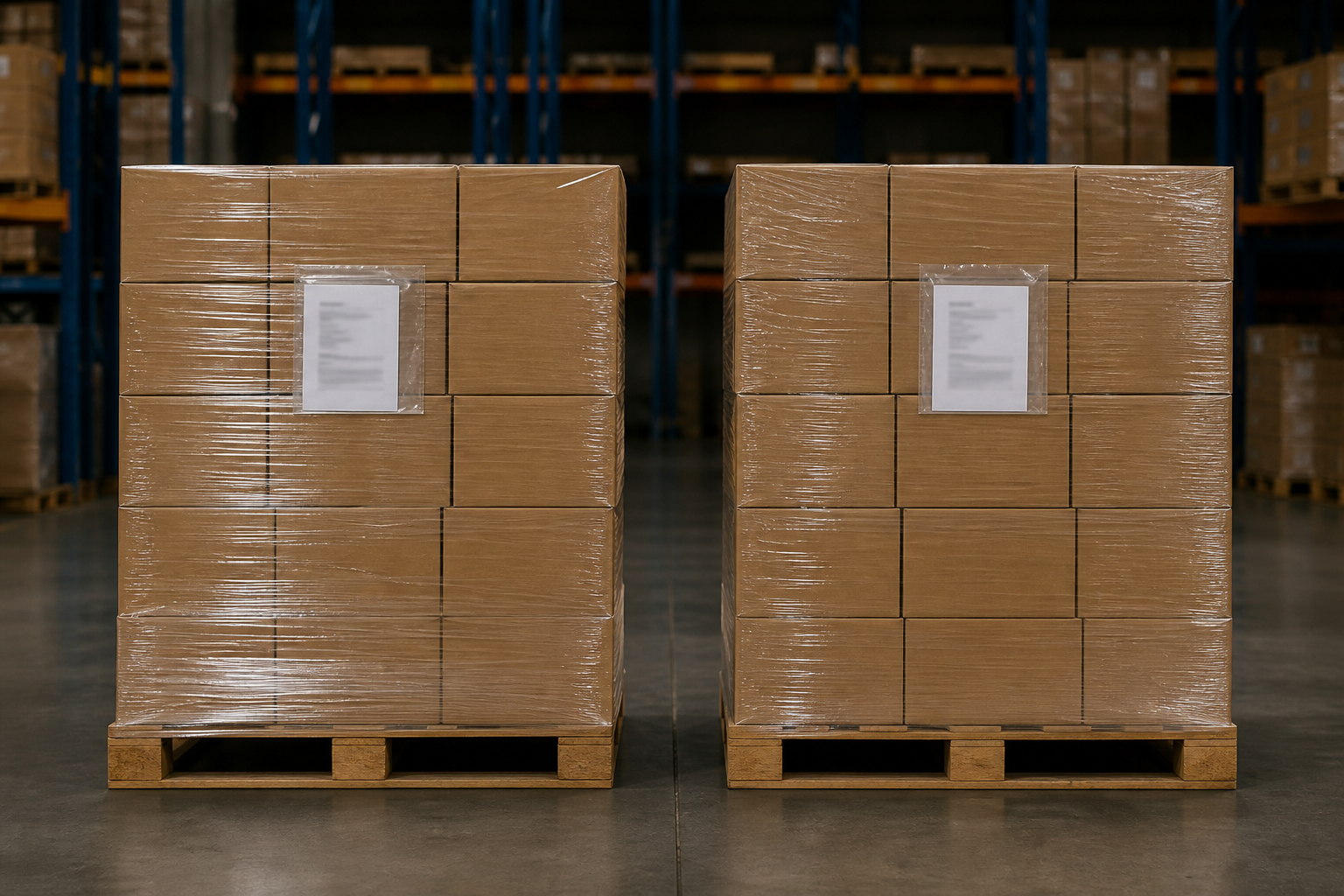
A buyer in Antwerp asks for DDP on 400 cartons of ceramic tableware, and the price is agreed in an afternoon. The next three weeks go on a different question: whether the seller, with no establishment in the EU, can be named as importer of record on the declaration its own quote just promised to file — and, separately, whether it can recover the import VAT it has just promised to pay.
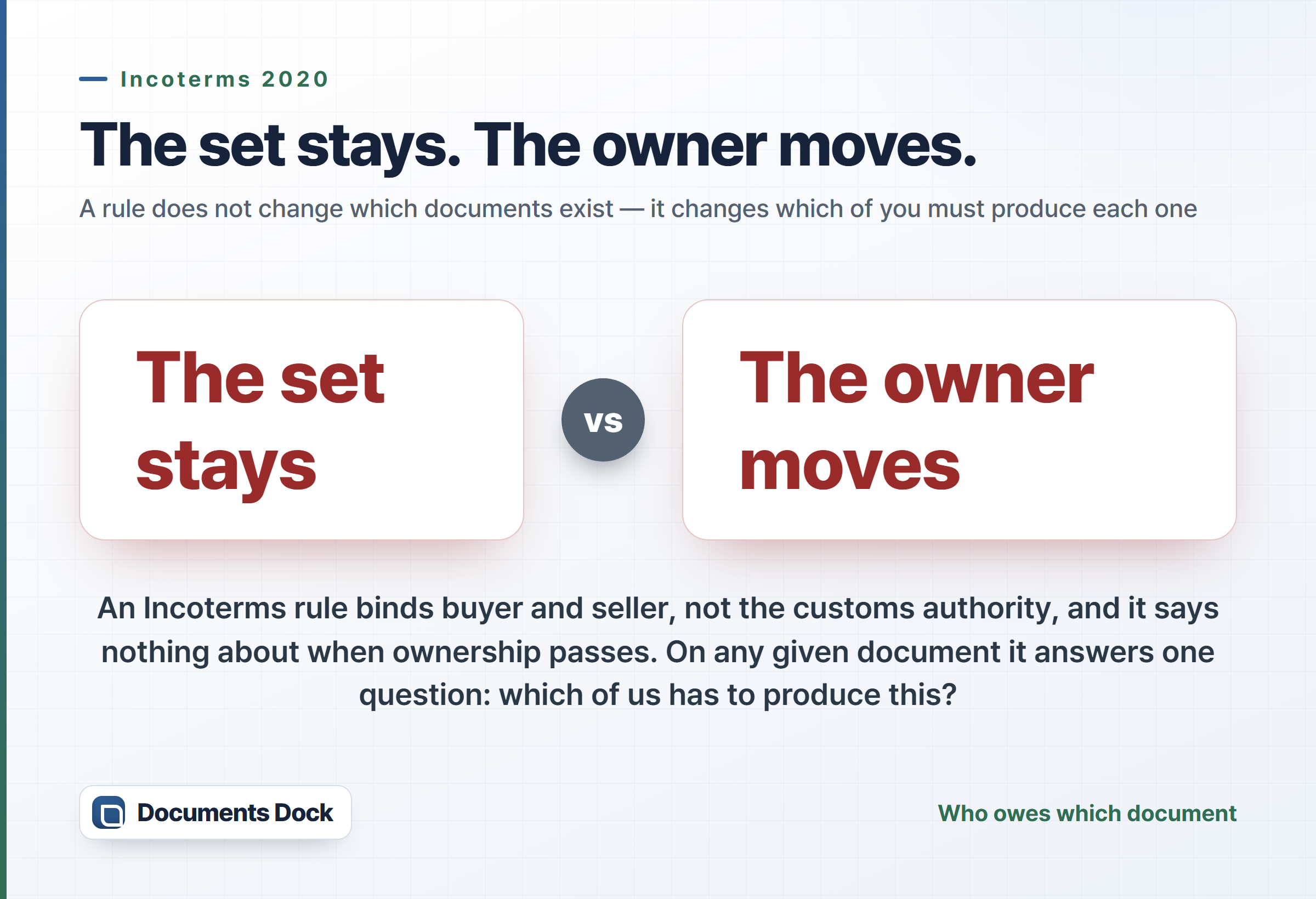
An Incoterms 2020 rule does not invent new kinds of document, but it decides which of them end up in your set, and who owes each one: which party files the export and import declarations, whether an insurance certificate belongs in the set at all, and what proof of delivery the seller must hand over. It binds buyer and seller, not the customs authority.
This guide reads the eleven rules as a document list. It does not re-teach who pays for freight or where risk passes — that is who pays for shipping, insurance, and customs — and it does not explain how to write each document; the order they arrive in is mapped in the full export document set, in order.
Which documents does each Incoterms 2020 rule put in the set?
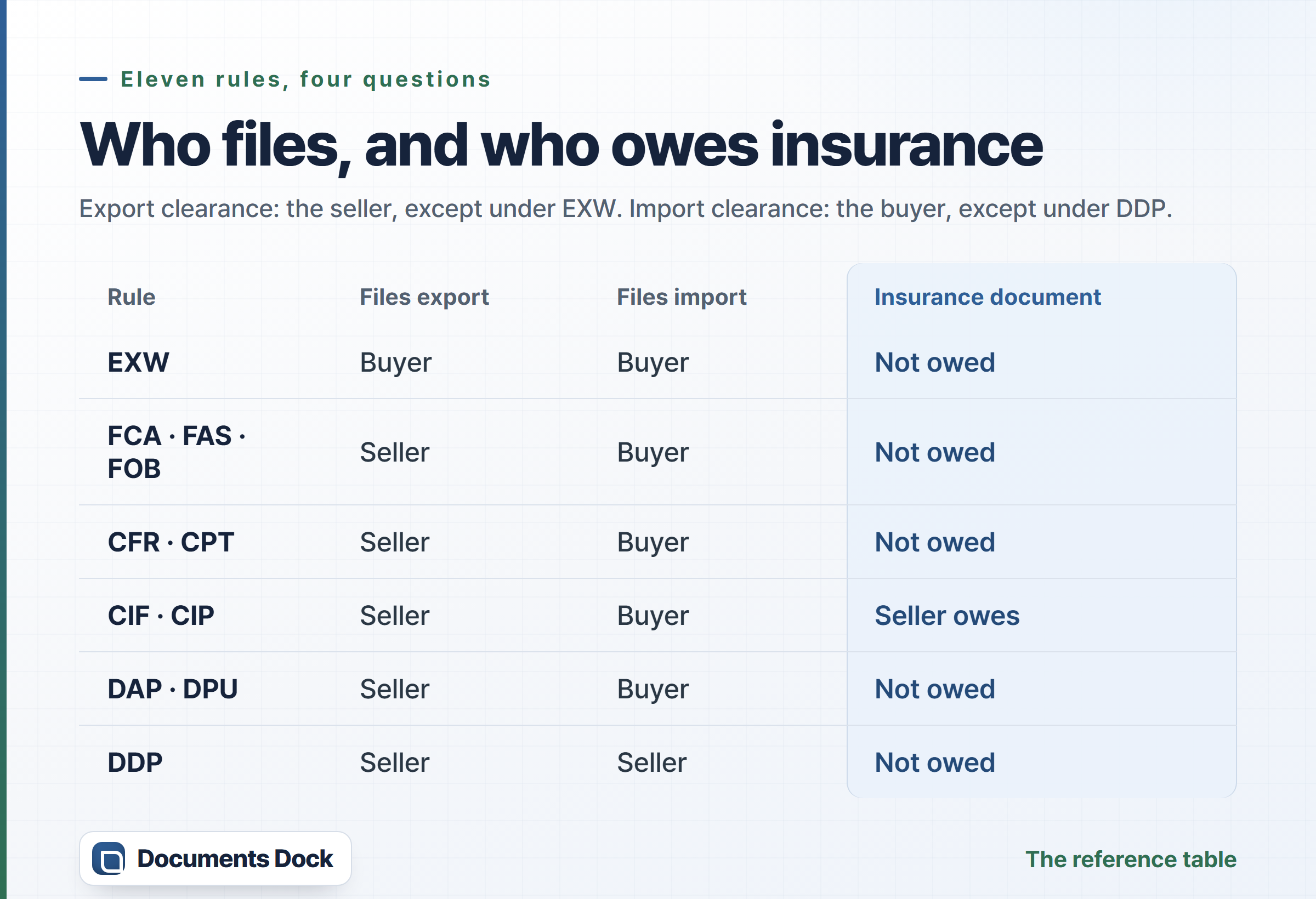
Each rule settles four things about the set: who files the export declaration, who files the import declaration, whether an insurance document is owed, and what the seller must hand the buyer as proof that delivery happened. The first three run the same way under almost every rule — the table below carries them. Only two rules add a document of their own.
Those two are CIF and CIP. Under both, the seller must obtain cargo cover for the buyer's benefit — Institute Cargo Clauses (C) or similar clauses under CIF, Clauses (A) or similar under CIP, unless the parties agree otherwise — and hand over the policy or certificate, so the buyer can claim directly from the insurer. That paper is then read against the invoice: amount insured (at least 110% of the contract price, in the contract currency), currency, route, and the term quoted a few lines above all have to agree, and where a documentary credit is involved its wording governs what will be accepted. How much cover each level actually buys is in the Incoterms 2020 cheat sheet.
What the seller must physically tender changes by family:
- **E — EXW.** Nothing. The rule gives the seller no proof-of-delivery obligation; it is the buyer that provides evidence of having taken delivery.
- **F — FCA, FAS, FOB.** The usual proof that the goods were delivered: handed to the buyer's carrier, placed alongside the nominated vessel, or loaded on board. Where that proof is not itself a transport document, the seller must assist the buyer — at the buyer's request, risk and cost — in obtaining one; under FCA that assistance is owed on request in any case. Under FCA the parties can also go further, which is the next section.
- **C — CFR, CIF, CPT, CIP.** Under CFR and CIF, the usual transport document for the agreed destination port: covering the contract goods, dated within the shipment period, and enabling the buyer to claim them at destination and, unless otherwise agreed, to sell them in transit — and where it is negotiable and issued in several originals, the full set. Under CPT and CIP it is owed where customary or at the buyer's request; CIF and CIP add the insurance certificate.
- **D — DAP, DPU, DDP.** Whatever document the buyer needs to take delivery at the named place. DPU was renamed from DAT in 2020 and is the only rule that requires the seller to unload at destination; DDP is the only rule under which the seller also files the import declaration and, unless the contract carves it out, pays duty and import taxes.
A credit can add a document the rule does not
'Not required' means only that the rule does not oblige it. A sale contract, a documentary credit, or an inspection requirement at destination can each put a certificate into the set that no Incoterms rule mentions — and which party produces it is still decided by the term you agreed.
Who files the export declaration, and who files the import declaration?
Export clearance falls to the seller under ten of the eleven rules; the exception is EXW. Import clearance falls to the buyer under ten of the eleven; the exception is DDP. Under DAP, DPU, and DDP the seller also handles any transit clearance on the way.
What moves with the term is a name, not a task. The party that clears is the party the authority has on record: whose identifier sits on the declaration, who holds the licence where one is needed, who keeps the evidence when the entry is reviewed years later. Handing the typing to a customs broker does not move that name — unless the broker is engaged in indirect representation, where it becomes the declarant in its own name and shares the liability. That, with a fiscal representative for the import VAT, is usually how a non-established DDP seller gets onto a European entry at all.
The duty to assist matters as much as the duty to file. Whichever side clears, the other must supply on request the information the filing needs — descriptions, values, origin evidence, licences — normally at the requesting party's risk and cost. Delays gather here rather than at the counter: the filing party waits on data held by the other.
The two exceptions are the ones that hand a party a declaration in the other side's country. EXW asks a foreign buyer to export from the seller's own country; DDP asks a foreign seller to import into the buyer's. Where zero-rating an export sale depends on holding evidence that the goods left, that evidence belongs to whoever did the exporting — under EXW, nominally the buyer. Retention runs the same way at the other end: a DDP seller answers for an entry filed in its own name for as long as the destination can reopen it.

Confirm who can be named on the declaration
A party can promise to clear and still be unable to appear on the form. Before the term goes into the contract, check with a licensed customs broker in that country whether whoever it appoints can be exporter or importer of record there, whether local registration is required, and whether the import tax is recoverable by the party paying it.
Why did Incoterms 2020 add an on-board bill of lading option to FCA?
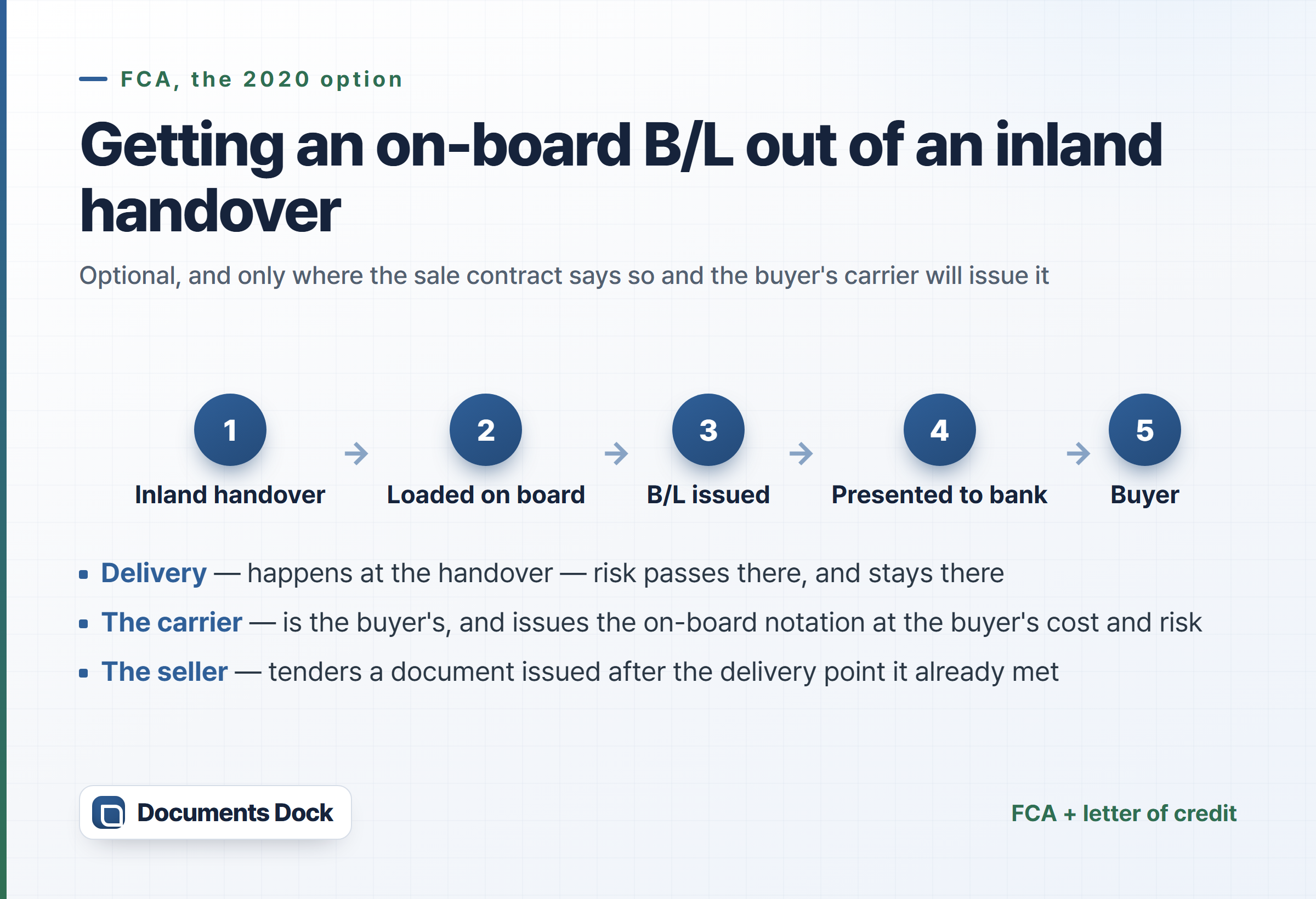
Because a very common combination did not work: a container sale on FCA and a letter of credit calling for an on-board bill of lading. Under FCA the seller delivers when the goods are handed to the buyer's carrier — often at an inland terminal, days before loading — and the document available at that moment is not an on-board bill of lading. The seller has performed and still cannot present what the bank asked for.
Incoterms 2020 answered it with an optional mechanism in FCA's delivery-document article. Buyer and seller may agree in the sale contract that the carrier — the buyer's, and at the buyer's cost and risk — issues the seller a transport document recording that the goods have been loaded: a bill of lading bearing an on-board notation. That is the document the seller then presents to the bank.
The option is optional in the strict sense: it exists only where the sale contract says so and the buyer's carrier will issue such a document. The delivery point does not move with it: risk still passed at the earlier handover, and the seller is now tendering a document issued after it. Where that agreement cannot be got in writing, amend the credit's document requirement or change the rule.
Which form of transport document you then ask for — a full set of originals, a telex release, or a sea waybill — is a separate decision, set out in telex release, original B/L, or sea waybill.
What does an Incoterms rule not decide?
Three things, each of them regularly mistaken for the rule's business. It does not transfer ownership: title passes under the law and the contract you chose, not under three letters. It is not the contract of carriage. And it does not bind the customs authority.
A customs authority applies its own law — who may declare, what evidence it wants, how the value is built up under its valuation rules — and the term you invoiced is one input among several. The rule tells you which party has to produce a document; the destination tells you whether that document will do.
Turn the agreed term into a document list
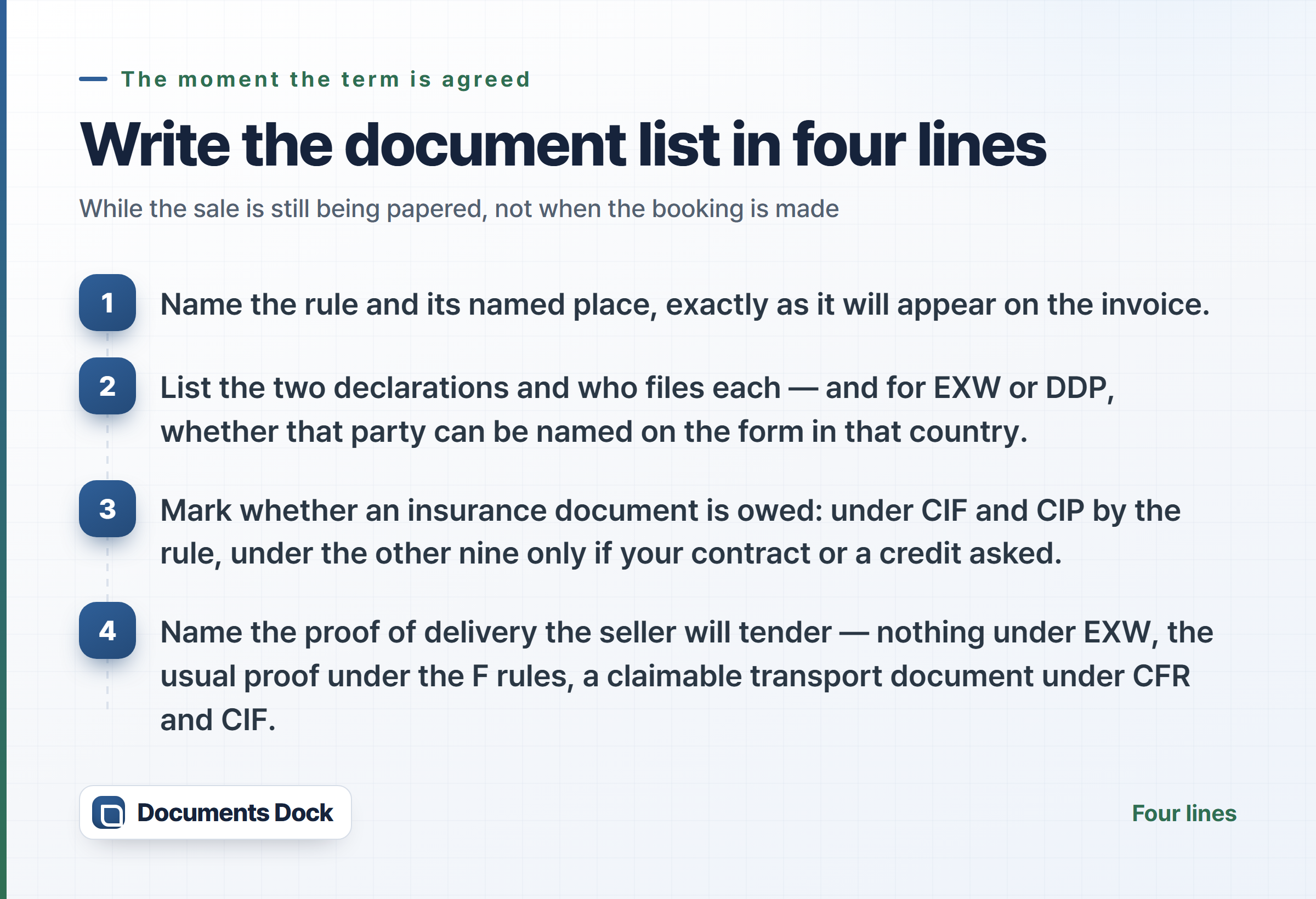
The moment the rule is agreed, the set is decided. Write it out then, in four lines, while the sale is still being papered:
- **The declarations, and the name on each.** Who files out, who files in — and, for EXW or DDP, whether that party can be named on the form in that country.
- **The insurance document, or its absence.** Owed under CIF and CIP. Under the other nine rules it joins the set only because your contract or your buyer's credit put it there.
- **The transport document the seller must tender.** Nothing under EXW; the usual proof under the F rules; under CFR and CIF a document the buyer can use to claim the goods at destination.
- **Whatever the contract and the destination add.** An inspection report, a preferential origin claim (do you need a certificate of origin?), and the invoice that quotes the rule with its named place (how to write a commercial invoice).
Two lanes, two sets
Two lanes to the same buyer under two different rules owe two different sets, and the difference never shows up in the price line.
Change the term and the set changes with it. Documents Dock re-reads each shipment against the rule it was sold on, so the pile you hand over is the one that term actually asks for — documentsdock.com.
Sources and scope
This is general information, not legal, customs, or insurance advice. Whether a party can be named as exporter or importer of record, and which documents a destination accepts, depend on your goods, your countries, and your contract. Check the term with a licensed customs broker in the country concerned, with your insurer, or with a legal adviser before it is signed into a sale contract.
Incoterms® is a registered trademark of the International Chamber of Commerce. The obligations above are paraphrased in plain language for orientation; the authoritative wording of each rule is the ICC's own.
- International Chamber of Commerce (ICC) — Incoterms® 2020 rules, including the FCA on-board bill of lading option and the DAT to DPU change (iccwbo.org/business-solutions/incoterms-rules/incoterms-2020)
- Lloyd's Market Association and International Underwriting Association — Institute Cargo Clauses (A) CL382 and (C) CL384, 01/01/2009, in the LMA wordings repository (lmalloyds.com)
- World Trade Organization — Agreement on Implementation of Article VII of GATT 1994, customs valuation (wto.org/english/tratop_e/cusval_e/cusval_e.htm)
- U.S. International Trade Administration — Know Your Incoterms (trade.gov/know-your-incoterms) and Common Export Documents (trade.gov/common-export-documents), cited as background; the per-rule clearance allocation above is attributed to the ICC rules text